









THE GENETICS OF THE GRULLA COLOR
A Medium-level Description for Novice Genetics Readers
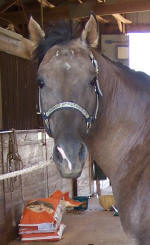
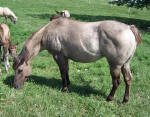
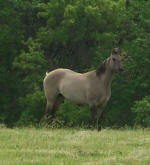
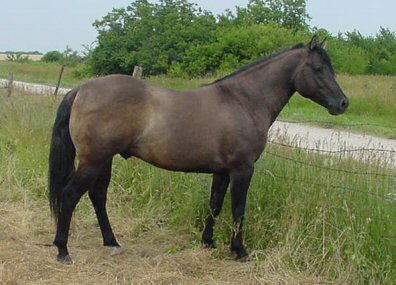
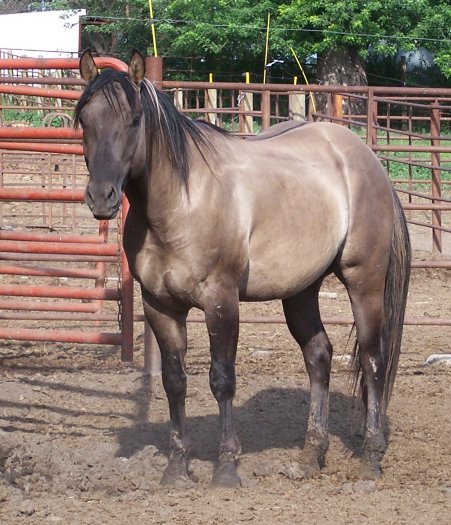
Click here for a more photo-based page about grullo color.
|
This will not be a technical description, but will be intended more for the person with a medium interest in learning about the grulla coat color (a beginner or person early in the learning stage).
The grulla color is a rare color (and
difficult to breed for) because the conditions must be "just
right" or else you get another color of foal. In order to have
a grulla foal, you need to have a foal with
-
black legs,
-
a genetically black (non-bay) body, and
-
dun factor.
There are some pretty basic factors/alleles (we'll call them genes, but
that's not quite correct) that mainly control this:
-
Red Factor
-
Agouti
-
Dun Factor
Before beginning, we need to lay some ground rules to simplify this as much as possible. For this simplification:
-
We are not discussing the effects of the gray gene (or many others) on these base colors, so for now, just ignore it
-
The color "red" when referring to "body color" also includes yellow as in palomino or dun or buckskin.
-
When a horse is "red based," it's typically a horse whose legs are not genetically black (such as a sorrel, palomino, red dun, etc.).
-
The term "body" includes the barrel, hip, head, and neck, but not the legs, mane, and tail
-
Each gene for a trait consists of a pair of alleles, with one coming from the sire and one coming from the dam
-
We are ignoring a lot of other stuff that will clutter this explanation up, and that would make it harder to understand
The First Oversimplification
Remember that I am going to oversimplify on this whole page in an attempt to make this a quick and easy thing to understand, and that this whole page is arranged according to how my own deranged mind works. :-) If you go on to read about color genetics, you'll realize here that some things (mainly vocabulary) aren't quite correct or are very oversimplified, but my goal wasn't to be 100% correct--it was to water down the genetics info to make it easier to understand. This page will actually help you understand genetics and help make you ready to go to that next level (that page is coming soon). Here are my first oversimplifications!
-
The color of the horse's legs is controlled by the E and e locus alleles (we'll call it a gene, though that's not quite correct). E is for black legs, and e is for red legs. One E will override any e, so any horse with an E (capital letter) will have black legs unless another modifying gene like double cream makes them white.
-
The color of the horse's body is partially controlled by the A and a locus as well as the E/e. An A means red/brown body, and an a means that the body will match the legs in color if there aren't other modifying genes. The A is dominant, so any horse with an A will have a red/brown-based body...not black/blue.
-
The dorsal stripe is controlled by the D and d alleles. Any horse with a D will be a shade of dun, where a horse that is dd (no capital D's) will not have dun factor.
Red Factor
The answer to the question, "Why are his legs red or black?"
Since grullas have black legs, we know that they must carry at least one black (non-red) gene. To correctly represent this, we really need to say that they should not carry two red genes, but instead should carry one or two non-red (black) genes. The black color is dominant over the red color, and is represented by the capital letter E. The red color is represented by the small letter e.
So, in regard to the red genes, there are three possibilities:
-
ee, which is a red-bodied horse with red legs
-
Ee, which is a black-legged horse. The body color depends upon the Agouti locus (below). This horse's foals can have either red or black legs.
-
EE, which is a black-legged horse that will always throw black-legged foals (this horse is commonly referred to as homozygous black)
Therefore, any horse with black legs must have one "E" or two "E" genes, and would be either Ee or EE. A red-based horse would be ee here. See http://www.vgl.ucdavis.edu/horse/redtest.html for more details, and information about testing for red factor.
Agouti
The answer to the question, "Why is his body red or black?"
The Agouti gene is a dominant gene, and if it is present in a foal in its dominant form, the foal can NOT be grulla (or black, or blue roan). The Agouti gene mainly affects the color of the body, but not the legs, mane, or tail. A sorrel (or any red-based) horse can have one or two Agouti genes, as can a bay (their bodies are red).
But a black, grullo, or blue roan horse cannot have any dominant Agouti genes, because they have black bodies. This is why blacks, grullos, and blue roans are so hard to get, and therefore are considered a recessive color. The capital letter A represents the red/brown body caused by the Agouti gene, while the small letter a represents the lack of the Agouti gene. Agouti possibilities are:
-
aa, which is a horse with a body color that matches its points (legs, mane, tail). There is no Agouti gene causing the body to be red. The body can be either red or black, depending upon the red/black genes (e and E) discussed above.
-
Aa, which is a horse whose body will always be red (never black). Note that "brown" horses might have mostly-black bodies, but they are not the same as an aa black. This horse can pass along the Agouti (A) gene, but won't always.
-
AA, which is a horse whose body will always be red (never black). Note that "brown" horses might have mostly-black bodies, but they are not the same as an aa black. This horse will ALWAYS pass along an Agouti gene to its foals, and therefore will never, ever have a true black, blue roan, or grullo foal.
To put those two together (red/black and Agouti), you can get the following combinations:
| Base Color | Red/Black | Agouti | Genotypes |
| Red colors (sorrel, palomino, etc.) | ee (no black hairs) | aa Aa, or AA (all with red legs and bodies bodies) |
ee aa, ee Aa, or ee AA (all sorrel/chestnut based) |
| Bay colors (bay, buckskin, dun, etc.) | Ee or EE | Aa or AA (black legs, red bodies) |
Ee Aa, Ee AA, EE Aa, EE AA (all bay based) |
| Black colors (black, grullo, blue roan, etc.) | Ee or EE | aa (black legs, black bodies) |
Ee aa, or EEaa (black based) |
Another comment or two about Agouti genes: The only ways to know for sure if a horse carries the Agouti (red body) gene are to have foals from the horse that express the color (bay-based colors), to have that horse actually expressing the gene (black legs with red/yellow body), to know the genetics of its parents, or to have him tested for color genetics (see the bottom of this page).
Many people think of the Agouti gene as being the "bay" gene, because it is what causes an otherwise black horse to be bay. In reality, the Agouti gene prevents blacks by turning them into bays (restricting the black to the legs, mane, tail). Keep in mind that sorrel/chestnut colors can carry the Agouti gene, even though they don't show it. Since their bodies are already red, you just can't tell visually that they may carry the dominant form of the Agouti gene.
Dun Factor
The answer to the question, "Why does he have a stripe down his back and dark tips on the backs of his ears?"
Now, the third gene/allele in the series: Dun factor. This gene causes more than one action on the above combinations, but in general it creates a distinct dorsal stripe running fully from the mane and into the tail, and also it dilutes the body color of the horse to a lighter (diluted) shade. There are other factors which cause stripes on horses' backs similar to dun stripes, but they are not true dorsal stripes. Very often, the dun gene will also cause dark ear tips, leg barring/striping, neck striping, face cobwebbing, and some other striping. The capital letter D represents dun factor, and the small letter d represents the lack of dun factor.
The dun locus can be represented as follows:
-
dd, or no dun markings (no dun factor)
-
Dd, or dun markings present. This horse will pass along dun factor markings to about half of his/her foals. At least one of this horse's parents was a dun-factored horse.
-
DD, or dun markings present. This horse will ALWAYS pass along dun markings to his/her foals. Both of this horse's parents must have carried the dun gene.
To make the table more complete, we can now add dun factor:
| Base Color | Red/Black | Agouti | Dun |
| Red colors (sorrel, palomino, etc.) | ee (no black hairs) | aa Aa, or AA (all with red legs and bodies bodies) |
dd, Dd, or DD |
| Bay colors (bay, buckskin, dun, etc.) | Ee or EE | Aa or AA (black legs, red bodies) |
dd, Dd, or DD |
| Black colors (black, grullo, blue roan, etc.) | Ee or EE | aa (black legs, black bodies) |
dd, Dd, or DD |
Now, just put the pieces together. I generally look first for black legs, and then for body color, and then on and on to determine the best guess for a horse's genotype. It is a process of elimination, kind of. For example.....
If a horse is ee Aa dd, it will be a sorrel or chestnut. The ee means it is a red horse. Aa means it has a red body (A), and dd means it does not carry dun factor, so it isn't a red dun, but rather is just a sorrel.
If a horse is ee AA Dd, it will be red dun. The ee means it is a red horse. AA means it has a red body (A), and Dd means it does carry dun factor, so it is a red dun instead of a sorrel.
Going in the other direction, if I see a horse that is red dun, I know it is ee (because it has no black legs), and that it has at least one dun allele (because it has a dorsal stripe). It is not possible to tell if it has an A, because the A only expresses itself visually if the horse has black legs and a red body. So, this horse is ee ?? D? for the placeholders of red factor, Agouti, and dun. The ? marks mean that I don't know what the horse has at that location in its genetic structure.
If a horse is Ee Aa dd, it is bay. E means black legs, so the Ee is a black-legged horse. Aa means red body, so this black-legged horse has a red body. The dd means no dun factor, so the horse does not become a dun...it stays bay.
Going in the other direction, if I saw a bay horse, I'd be able to tell certain things about it. First, it has black legs so I know it has at least one E (but I don't know for sure if the other is e or E). Secondly, I know it has at least one A, because it has a red body with black legs, but I don't know if the other allele there is A or a. I also know it has no dun factor, so it is dd. Therefore, I know that for those three traits, the horse is E? A? dd.
If the horse changes slightly, so that it is aa instead of Aa, then it does NOT have a red body. So if it is Ee aa dd, it would be black-legged (Ee), no red body (aa), and dd means no dun. It's a black-legged, black bodied horse...it's a black!
What if that same horse was a dun-factored horse? It would be Ee aa Dd, so it would be black legged (Ee), no red body (aa), and have a dorsal stripe (Dd). What is a black-legged horse with a dorsal stripe that does not have a red body? A grulla!
The next step is to figure out what the likelihood of your horse's foal's color will be, using the genetics of the mare and the stallion!
Links
http://www.vgl.ucdavis.edu/services/horse.php University of CA Davis Horse Genetics Page
Test your foal or horse...how to be SURE of his/her genetics! Click here for the University of California at Davis's genetics test form. Or, visit www.petdnaservicesaz.com for an alternative testing site (may be cheaper).
http://www.vgl.ucdavis.edu/horse/redtest.html Red Factor Test Information
http://www.vgl.ucdavis.edu/horse/redfactr.htm Red Factor Test KIT for sending in samples to have your horses tested
This page last updated 07/15/11
References:
Knowledge gained over the years from books, articles, and acquaintances made vie e-mail and phone.
Dr. Phillip Sponenberg, DVM, Ph D. Equine Color Genetics.
Special thanks to Pam T. of the Everafter Ranch for helping me proofread this, and keep it fairly correct and yet simple!
Photo Ownership Notice:
All of the photos on this page are the property of Cedar Ridge QH's or were
sent to us with permission.
If someone has sent a photo to us for use on our pages that belongs to you,
and if they did not have
permission to do so,
please let us know.
If you are interested in contributing a photo, we thank you! But please do not
alter the photo or place your contact
information on it. Our educational pages are for just that...education. Not
advertisements. Thanks!
|
This page last updated
05/28/21
If you notice this date being 2 years or older, please let
us know that we need to check out this page!
Home Horses For Sale Stallions Mares Foals Blog Color Genetics Riding Horses Site Map Contact Us

Toni Perdew
Bedford, Iowa
toni@grullablue.com
712-370-0851 cell, before 9 p.m. CST

www.facebook.com/CedarRidgeQuarterHorses
Web design by
CR
Equine Sites.
All rights reserved. Graphics are watermarked for copyright protection.
Terms of Use