









THE (simplified) GENETICS OF THE BLUE ROAN COLOR
A Medium-level Description for Novice Genetics Readers
|
Genetics Roan vs. Gray Shades of Roan Non-roan Roaning Foal Coat Colors Linked Gene Theory
This will not be a technical description, but will be intended more for the person with a medium interest in learning about the blue roan coat color (a beginner or person early in the learning stage).
What are the Differences in the Shades of Roans?
This is a controversial issue! In my opinion, many
people who have bay roans want to call them blue roans because the blue
roans are more valuable and rare, and because they were a cross between
red and blue roan colors. But to me, if a horse is
genetically a bay with roan, it is not a true blue roan. Some disagree, but I represent it that way so that I'm not cheating anyone
who is buying from me or breeding to my stallion--I believe in being
honest about their horse or their future foal, and this is the safest
and most honest way to represent the roan shades.
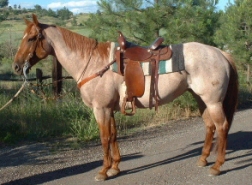 Red Roan (sorrel based) AQHA calls these "Red Roans" but many people refer to them as "Strawberry Roans." |
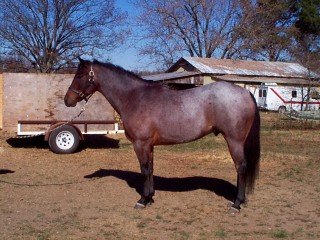 Bay Roan (bay-based). Note the BAY face. AQHA now correctly wants these to be called "Bay Roans", though many people mistakenly call them Blue Roans. |
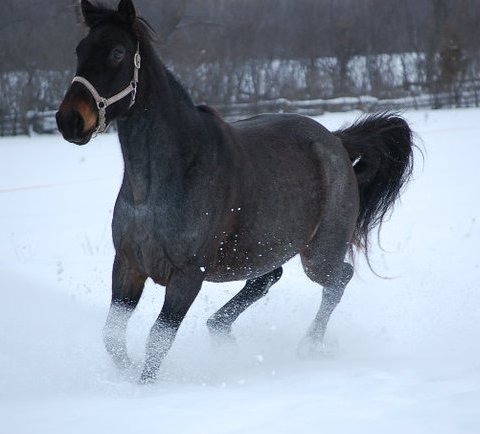
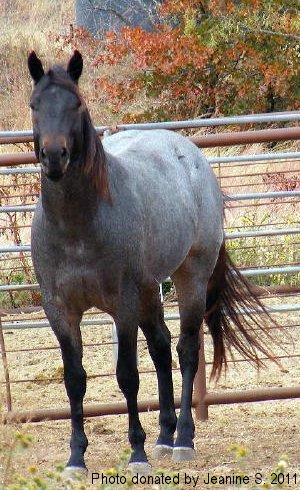
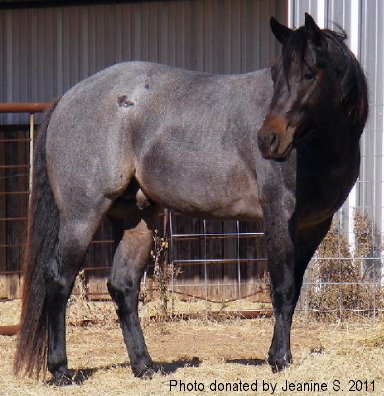 Brown Roan (seal brown + roan) Can have a red or blue body, but shows the seal brown base color on the muzzle, and typically behind elbows and at the flank. |
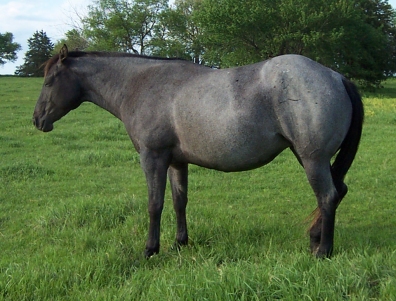 Blue Roan (black-based). Note the BLACK face, and FEW or NO red hairs on the horse. |
Note: AQHA changed its color rule in 2002 to allow for a distinction between sorrel-based roans and bay-based roans. Prior to this, both those colors were referred to as Red Roan.
Genetics Roan vs. Gray Shades of Roan Non-roan Roaning Foal Coat Colors Linked Gene Theory Back to Top
The Basics of Blue Roans
The blue roan color is a rare color (and difficult to breed for) because the conditions must be "just right" or else you get another color of foal. In order to have a blue roan foal, you need to have a foal with
- black legs,
- a genetically black body, and
- roaning.
There are some pretty basic factors/alleles (we'll call them genes, but that's not quite always correct) that mainly control this:
- Red Factor
- Agouti
- Roan
Before beginning, we need to lay some ground rules to simplify this as much as possible. For this simplification:
-
We are not discussing the effects of the gray gene (or many others) on these base colors, so for now, just ignore those. See the bottom of the page for the way to tell roans from grays.
-
The color "red" also includes yellow as in palomino or dun or buckskin
The term "body" includes the barrel, hip, head, and neck, but not the legs, mane, and tail
Each gene for a trait consists of a pair of alleles, with one coming from the sire and one coming from the dam
We are ignoring a lot of other stuff that will clutter this explanation up, and that would make it harder to understand
The First Oversimplification
Remember that I am going to oversimplify on this whole page in an attempt to make this a quicker and easier thing to understand.
If you go on to read about color genetics, you'll realize here that some things (mainly vocabulary) aren't quite correct or are very oversimplified, but my goal wasn't to be 100% correct--it was to water down the genetics info to make it easier to understand. This page will actually help you understand genetics and help make you ready to go to that next level (that page is coming soon). Here are my first oversimplifications!
-
The color of the horse's legs is controlled by the E and e locus alleles (we'll call it a gene, though that's not quite correct). E is for black legs, and e is for red legs. One E will override any e, so any horse with an E (capital letter) will have black legs.
-
If a horse has black legs, the color of the horse's body is controlled by the A and a locus. An A means reddish body, and an a means that the body will match the legs in color. The A is dominant, so any horse with an A will have a red-based body.
-
The roaning is controlled by the R and r alleles. Any horse with a R will be a shade of roan, where a horse that is rr (no capital R's) will not have roaning.
Red Factor
The answer to the question, "Why are his legs red or black?"
Since blue roans have black legs, we know that they must carry at least one black (non-red) gene. To correctly represent this, we really need to say that they should not carry two red genes, but instead should carry one or two non-red (black) genes. The black color is dominant over the red color, and is represented by the capital letter E. The red color is represented by the small letter e.
So, in regard to the red genes, there are three possibilities:
- ee, which is a red-bodied horse with red legs
- Ee, which is a black-legged horse. The body color depends upon the Agouti locus (below). This horse's foals can have either red or black legs.
- EE, which is a black-legged horse that will always throw black-legged foals (this horse is commonly referred to as homozygous black)
Therefore, any horse with black legs must have one "E" or two "E" genes, and would be either Ee or EE. A red horse would be ee here. See http://www.vgl.ucdavis.edu/horse/redtest.html for more details, and information about testing for red factor.
Agouti
The answer to the question, "Why is his body red or black?"
A horse's body color is controlled by the black gene (E) above. However, if a horse has black legs, its body can still be red/brown if the horse has a dominant form of the Agouti allele.
The Agouti gene is a dominant gene, and if its dominant form (A) is present in a foal, the foal can NOT be blue roan (or black, or grulla). The Agouti gene mainly affects the color of the body, but not the legs, mane, or tail. A sorrel horse can have one or two Agouti genes, as can a bay (their bodies are red). But a black, grullo, or blue roan horse cannot have any dominant Agouti genes, because they have black-colored bodies. This is why blacks, grullos, and blue roans are so hard to get. The capital letter A represents the red body caused by the Agouti gene, while the small letter a represents the lack of the Agouti gene (which allows for black bodies). Agouti possibilities are:
-
aa, which is a horse with a body color that matches its points (legs, mane, tail). There is no Agouti gene causing the body to be red. The body can be either red or black, depending upon the red/black genes (e and E) discussed above.
-
Aa, which is a horse whose body will always be red (never black). This horse can pass along the Agouti (A) gene, but won't always.
-
AA, which is a horse whose body will always be red (never black). This horse will ALWAYS pass along an Agouti gene to its foals, and therefore will never, ever have a true black, blue roan, or grullo foal.
To put those two together (red/black and Agouti), you can get the following combinations:
Base Color Red/Black Agouti Genotypes Red colors (sorrel, palomino, etc.) ee (no black hairs) aa
Aa, or
AA
(all with red legs and bodies bodies)ee aa, ee Aa, or
ee AA
(all sorrel/chestnut)Bay colors (bay, buckskin, dun, etc.) Ee or EE Aa or
AA
(black legs, red bodies)Ee Aa, Ee AA, EE Aa, EE AA (all bay based) Black colors (black, grullo, blue roan, etc.) Ee or EE aa
(black legs, black bodies)Ee aa, or EEaa
(black based)Another comment about Agouti genes: The only ways to know for sure if a horse carries the Agouti (red body) gene are to have foals from the horse that express the color (bay-based colors), to have that horse actually expressing the gene (black legs with red/yellow body), to know the genetics of its parents, or to have him genetically tested (see the bottom of this page for information). Many people think of the Agouti gene as being the "bay" gene, because it is what causes an otherwise black horse to be bay. In reality, the Agouti gene prevents blacks by turning them into bays. Keep in mind that sorrel/chestnut colors can carry the Agouti gene, even though they don't show it. Since their bodies are already red, you just can't tell they may carry the Agouti gene.
Genetics Roan vs. Gray Shades of Roan Non-roan Roaning Foal Coat Colors Linked Gene Theory Back to Top
Roaning
The answer to the question, "Why does he have a mixture of white and dark hairs or else solid silvery-white hairs on his barrel, hips, neck, and shoulders?"
Now, the third gene/allele in the series: roan. This gene creates a body and hip that is a variation of white or white mixed with the head color. During the short-hair times of year (summer and adjoining seasons), roan horses will have dark heads (bay, sorrel, black) but bodies ranging from salt and pepper coloring to pearly to metallic white! The capital letter R represents roan, and the small letter r represents the lack of roaning.
The roan locus can be represented as follows (but is also known as Rn and rn):
-
rr, or no roan markings
-
Rr, or roan pattern present. This horse will pass along roan pattern to about half of his/her foals. At least one of this horse's parents was a roan horse.
-
RR, or roan markings present. This horse will ALWAYS pass along roan markings to his/her foals. Both of this horse's parents must have carried and shown the roan gene. This type of horse is very rarely found because it is theorized that the fetus dies in-utero when it carries two roan genes. Some exceptions do reportedly exist, so there is controversy as to whether the RR embryo does die or not. See Equine Color Genetics by Dr. Phillip Sponenberg, 1996, p. 58 for more information on this theory.
-
Newsflash! Dr. Anne Bowling of the University of California at Davis disproved the above theory before her death. The original study that started that theory of lethal homozygous fetuses was never replicated, and she did a study and proved that the percentages of foals with and without color followed the statistical projection as if there was NO lethal state. So, according to the modern research (2002, I believe), it is just fine to breed two roans together. Statistics for live foals will match any other color matings.
To make the table more complete, we can now add roan:
Base Color Red/Black Agouti Roan Red colors (sorrel, palomino, etc.) ee (no black hairs) aa
Aa, or
AA
(all with red legs and bodies bodies)rr, Rr or RR Bay colors (bay, buckskin, dun, etc.) Ee or EE Aa or
AA
(black legs, red bodies)rr, Rr or RR Black colors (black, grullo, blue roan, etc.) Ee or EE aa
(black legs, black bodies)rr, Rr or RR Now, just put the pieces together. I generally look first for black legs, and then for body color, and then on and on to determine the best guess for a horse's genotype. It is a process of elimination, kind of. For example.....
If a horse is ee Aa rr, it will be a sorrel or chestnut. The ee means it is a red horse. Aa means it has a red body (A), and rr means it does not carry roan factor, so it isn't a strawberry roan, but rather is just a sorrel.
If a horse is ee AA Rr, it will be strawberry roan. The ee means it is a red horse. AA means it has a red body (A), and Rr means it does carry roan factor, so it is a roan instead of a sorrel.
Going in the other direction, if I see a horse that is strawberry roan, I know it is ee (because it has no black legs), and that it has at least one roan allele (because it has roaning). It is not possible to tell if it has an A, because the A only expresses itself visually when the horse has black legs and a red body. So, this horse is ee ?? R? for the placeholders of red factor, Agouti, and roan. The ? marks mean that I don't know what the horse has at that location in its genetic structure.
If a horse is Ee Aa rr, it is bay. E means black legs, so the Ee is a black-legged horse. Aa means red body, so this black-legged horse has a red body. The rr means no roan, so the horse does not become a roan...it stays a black-legged horse with a red body: a bay.
Going in the other direction, if I saw a bay horse, I'd be able to tell certain things about it. First, it has black legs so I know it has at least one E (but I don't know for sure if the other allele is e or E). Secondly, I know it has at least one A, because it has a red body with black legs, but I don't know if the other allele there is A or a. I also know it has no roaning, so it is rr. Therefore, I know that for those three traits, the horse is E? A? rr.
If the horse changes slightly, so that it is aa instead of Aa, then it does NOT have a red body. So if it is Ee aa rr, it would be black-legged (Ee), no red body (aa), and rr means no roan. It's a black-legged, black bodied horse...it's a black!
What if that same horse was a roan? It would be Ee aa Rr, so it would be black legged (Ee), no red body (aa), and have roaning (Rr). What is a black-legged horse with roaning that does not have a red body? A blue roan!
Genetics Roan vs. Gray Shades of Roan Non-roan Roaning Foal Coat Colors Linked Gene Theory Back to Top
What do roan foals look like?
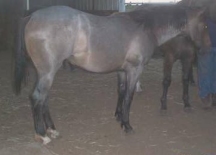
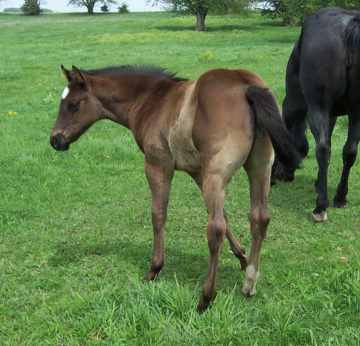
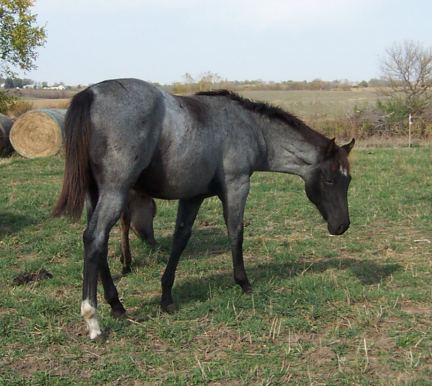
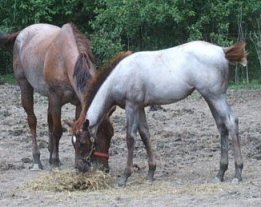
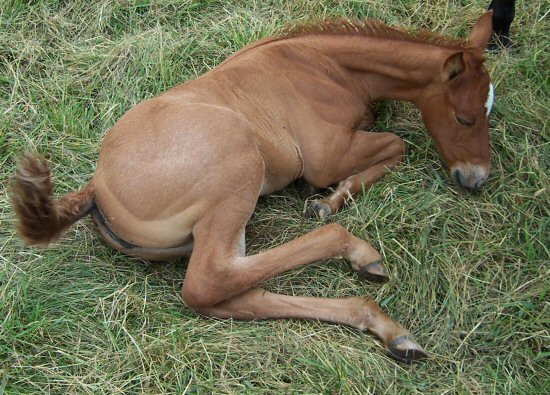
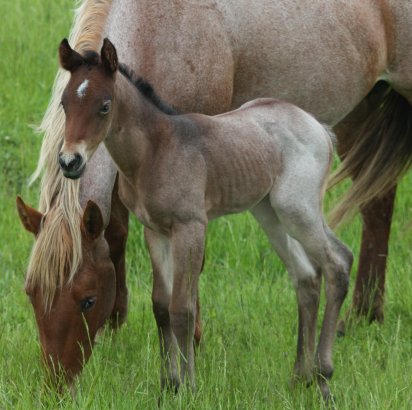
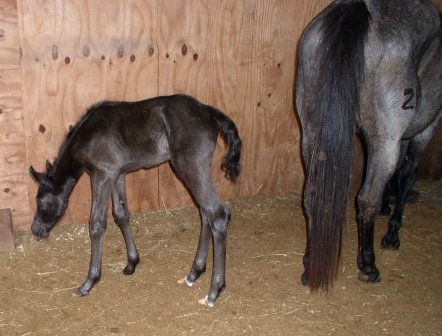
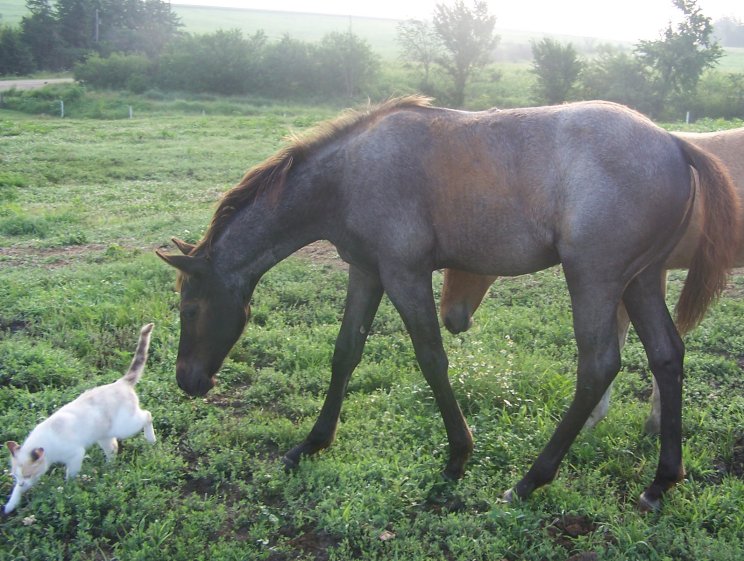
This can vary a lot. Some foals are born with obvious roaning, and cannot be mistaken for roan foals from the beginning. Others are born with no obvious roaning, but shed off to become roan to the surprise of their owners.
To know for sure, one can only wait. But lifting the hairs on the hips and above the tail can provide early clues. If the underhair is white or silver, then the foal may roan. Below are a couple of pictures of roan foals with their foal coat and also after shedding. Roans generally show their roan coloring by a few months of age. Roans are not considered to intensify in roaning as they age. That is generally a characteristic of grays.
Coat
With foal coat color:
After shedding foal coat:
Foal #1
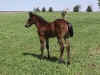
Looks bay, but....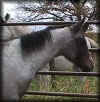
What a color difference!Foal #2
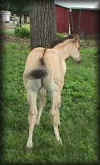
Born grullo...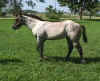
Shed off grullo roan (blue roan variation)Foal #3
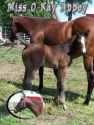
Born bay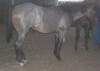
Shed off bay-based roanFoal #4
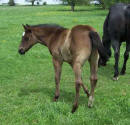
Born black/brown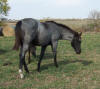
Shed off blue roan (black head)Foal #5
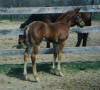
Born chestnut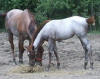
Shed off liver-based roan
(red roan), which is genetically the same as strawberry/red roan.Foal #6
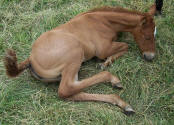
Born sorrel, but showing some roaning.
Some do and some don't show roaning right from birth.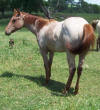
Shed off red roan/strawberry roanFoal #7
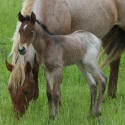
Born bay roan. This foal is unusual in that it is very roaned right from birth.Foal #8
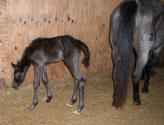
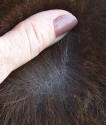
Born looking black with NO roaning (left).
Roaning becoming evident at 2 1/2 months of age (right)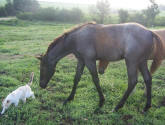
Genetics Roan vs. Gray Shades of Roan Non-roan Roaning Foal Coat Colors Linked Gene Theory Back to Top
What is the Difference Between Roans and Grays?
Roan and gray are caused by two different genes. To tell the difference between the two, look at the head.
Roan:
If the horse's head is darker than its body, it is probably a roan.
Roans generally have a mane and tail that are solid and dark in color when compared to the color of the body.
Roans do NOT turn lighter and lighter as years go by. They always retain their dark-colored heads, legs, manes, and tails.
Roans can have any color under the roan, from sorrel, to buckskin, to grullo. Any color of horse can also be a roan if it had a roan parent and if it expresses the roan gene.
Most roans will be intensely-colored during the winter (they will look much like a non-roan), but will be roaned out during the summer.
Gray:
If the head is lighter than the body, or if it is turning lighter every year, the horse is a gray.
Grays that are mature will also have a mane and tail that is usually lightening up and turning gray.
Grays usually begin turning gray by weaning time, although some rare cases do not show much graying until they are 5 or more years old.
Grays may darken a little in the winter, but each spring, they shed out a little lighter until they are finally their final shade of gray/white/fleabitten gray.
Many roan breeders like to cross on gray mares, but I am concerned with that practice. They think the gray gene will accentuate the roan gene, but it doesn't...it covers it up! The result is that some people are buying foals that they think are roan, and that are being represented and priced as roan foals. But by the time the foal is 5 years old, it's just a plain old gray. While grays are also popular, if someone buys a roan because they like roan, they may be in for a major disappointment if that roan turns into a gray. My suggestion to you, as a buyer, is to be wary of buying a "roan" foal that has a "gray" parent.
As a breeder, my hope is that you'll try to accurately represent foals resulting from roan to gray crosses, and even to educate the buyer so they are prepared in the event that the foal turns gray.
Learn more about Roan vs Gray colors by clicking HERE.
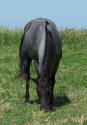
Roan. Note that the head/face is darker than the body. This horse will not turn white, and will always retain black legs, mane, tail, and head.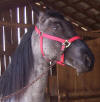
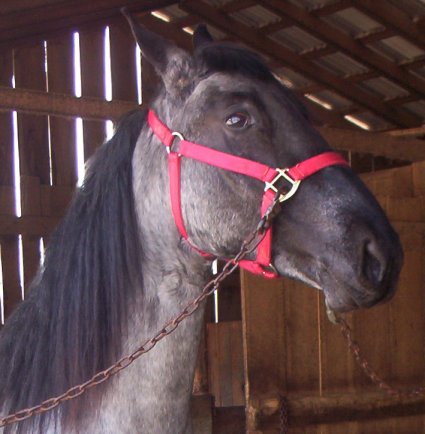
Blue roan face of a Tennessee Walker. Note that the roaning is less around the eyes. Normally, this is true of roans, but with some variations and exceptions.
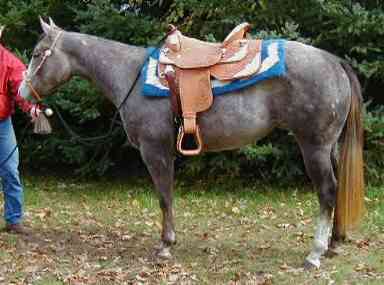
Gray. Note that the face is lighter than the body, and the tail is lightening. This horse will eventually become nearly white or fleabitten gray.Genetics Roan vs. Gray Shades of Roan Non-roan Roaning Foal Coat Colors Linked Gene Theory Back to Top
Effects Often Mistaken for Roan
White ticking is a unique and eye-catching roan-like pattern of white hairs that is mainly concentrated in the flank area. This ticking can spread toward the top of the hip and toward the withers, but doesn't cover the whole hip, belly, back, and neck of a horse like roaning caused by the roan allele does. It often appears in conjunction with coon tail, which is white striping at the top of the tail.
Specific kinds of ticking include that caused by the sabino and by rabicano patterns. Click here to learn more about white patterns other than roan.
This attractive ticked horse is Absolute Investment, a rabicano-patterned Quarter Horse stallion. Click his name to see his web page, or his photo to see the white ticking up close. This little pony is neither roan nor gray, and is probably exhibiting lots of sabino white pattern. 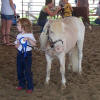
Lauren and FrostyGray. Click here to learn more about grays, and how to tell them apart from roans. Roan Gene Linked to Red Factor?
Some genetics experts believe that the roan gene is linked to each roan horse's Red Factor allele. For example, if a horse is heterozygous for black and heterozygous for roan (E/e Rn/rn), some believe that the roan gene is either "attached" (poor wording) to the E (black) or e (red) allele.
As an example, lets say that a blue roan stallion's roan is attached to his E allele. If this is true, that stallion could never sire a red roan foal from non-roan mares, as his recessive "e" does not pass with his roan. His roan is attached to his E (black) allele, and any foal inheriting that would have genetically-black legs...so no red roan offspring would come from him.
In the other direction, let's say that a blue roan stallion is Ee, but his roan is attached to the "e" instead of his "E" allele. If this theory is true, that stallion could never sire a foal that is both homozygous for black AND homozygous for roan. His foals would only inherit his roan gene IF they also inherited his "red" (e) gene.
How about a stallion that is EE and Rn/rn? That makes it harder! ALL of that stallions will inherit the E ("black," or "non-red") gene from him. So, his foals would be difficult to use in a study, I suppose. To prove the theory, following Ee Rn/rn stallions would be necessary (unless I need more coffee at the time I'm typing this to activate my brain!).
This is hard to track without looking at large numbers, and knowing the stallions' and ALL the mares' genetics for E and Rn, and also testing foals for zygosity.
At this time, I'm looking for valid research that supports gene linkage between Roan and Red Factor. If I find it, I will post more information here.
Genetics Roan vs. Gray Shades of Roan Non-roan Roaning Foal Coat Colors Linked Gene Theory Back to Top
Click here to request help determining your horse or foal's color
Links
http://www.hancockhorses.com/article-roanQHNews.pdf Article about HOMOZYGOUS ROAN study.
References
Knowledge gained over the years from books, articles, and acquaintances made vie e-mail.
Dr. Phillip Sponenberg, DVM, Ph D. Equine Color Genetics.
http://www.vgl.ucdavis.edu/~lvmillon/ University of CA Horse Genetics Page
Photo Ownership Notice:
All of the photos on this page are the property of Cedar Ridge QH's or were sent to us with permission.
If someone has sent a photo to us for use on our pages that belongs to you,
and if they did not have permission to do so, please let us know.
If you are interested in contributing a photo, we thank you! But please do not alter the photo or place your contact
information on it. Our educational pages are for just that...education. Not advertisements. Thanks!
Equine Color and Genetic Testing LabsThere are many laboratories in the US and around the world that do horse color testing, disease testing, etc. When you choose a lab, make sure it is a reputable one! There are several university-related labs, which I recommend, and many private labs (some of which can NOT be recommended!). Here are a few I'm familiar with:
University Laboratories:
-
University of California at Davis: http://www.vgl.ucdavis.edu/services/horse.php
-
Cornell University: http://ahdc.vet.cornell.edu/
-
University of Kentucky: http://www.ca.uky.edu/gluck/AGTRL.asp#color
-
University of Minnesota: http://www.vdl.umn.edu/ourservices/equineneuromuscular/home.html (disease testing)
Private Laboratories:
-
Animal Genetics, Inc. http://www.horsetesting.com/Equine.asp
-
PROCEED WITH CAUTION IF YOU CHOOSE TO USE THIS LAB, BELOW, in my opinion:
DNA Diagnostics (aka Shelterwood Labs, and also affiliated somehow with Catgenes.Org) http://www.dnadiagnostics.com/ DNA Diagnostics/Shelterwood Labs offers a test for multiple characteristics at one price. I had seen a fair bit of chatter online about how they cash the checks and don't give the results of the test. So, I tested them by paying for three horse tests. Guess what...they sent back two of my horses' test results and after 4 1/2 months, the third was still missing in action! Repeated phone calls and e-mails were ignored by the lab. Finally, five months after the test, someone gave me the results for the third horse.
If you choose to use this lab, my opinion is to only send them as much money as you are willing to lose, in case you don't receive your results. Update: A friend just called that used this lab and she still hasn't received her results after many months of waiting, phone calls, and e-mails. 3/2010. I know of another horse that tested homozygous for black that is not homozygous, as he has produced sorrel and palomino foals. In both cases, Shelterwood does not return their repeated phone calls.
How To Donate Your Educational Photo:
-
If you are wondering what color your foal is, click here. We are having a lot of people send us pictures for this page where it is obvious that the foal owners don't know what color their foal is. Please, only send us photos for this page if you know your foal's color. If you don't know what color your foal is, click here.
-
If you foal is a Paint or Appaloosa, we will only use it if the vast majority of the foal's body is not included in the white patterned areas, as this page is intended to help people determine foal colors, so the colored hairs must be very obvious.
-
This is an educational page, and photos should show a safe environment and healthy horses. I don't even know how to respond when I receive photos of wormy, skinny horses in pastures littered with abandoned cars, farm equipment, wire fences laying on the ground, and falling-down buildings. I simply can't put photos like that on an educational page like this, where people come to learn.
-
Please note that this is not intended to be a free opportunity for you to advertise your breeding operation, and instead is an educational page. We will not use photos with watermarks/writing on them. There are many free advertising sites on the Internet at which you can advertise your farm/ranch/horses. Also, only send photos of foals you own. This way, there won't be copyright problems.

Feel free to click the "Send Your Photo" logo at the left to send a good photo or two to us for inclusion on our color pages.Photo Ownership Notice:
All of the photos on this page are the property of Cedar Ridge QH's or were sent to us with permission.
If someone has sent a photo to us for use on our pages that belongs to you,
and if they did not have permission to do so, please let us know.
If you are interested in contributing a photo, we thank you! But please do not alter the photo or place your contact
information on it. Our educational pages are for just that...education. Not advertisements. Thanks!






Home Horses For Sale Stallions Mares Foals Blog Color Genetics Riding Horses Site Map Contact Us

Toni Perdew
Bedford, Iowa
toni@grullablue.com
712-370-0851 cell, before 9 p.m. CST

www.facebook.com/CedarRidgeQuarterHorses
Web design by
CR
Equine Sites.
All rights reserved. Graphics are watermarked for copyright protection.
Terms of Use